Shadows and Light: The Ancient Art of Jali Work
Architecture is, at its most profound, the masterful and deliberate play of masses brought together in light. Few architectural features demonstrate this interplay of solidity and light more beautifully than the traditional Indian Jali.
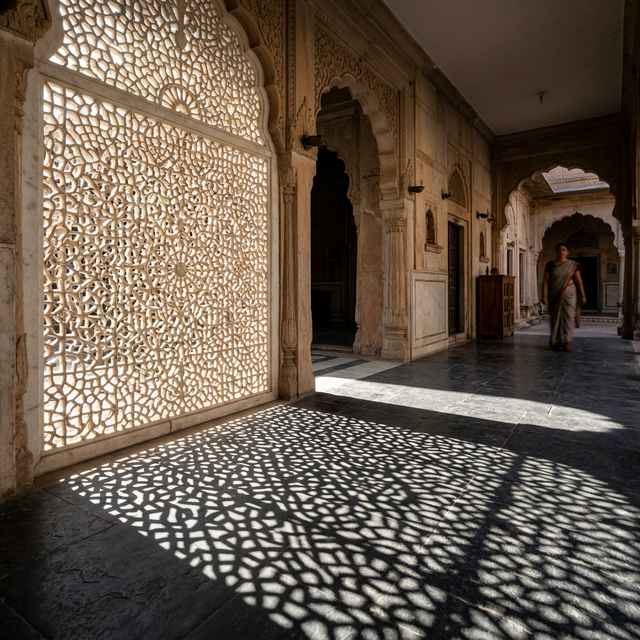
A jali is a perforated stone or latticed screen, characterized by an ornamental pattern constructed through the use of calligraphy, geometry, floral motifs, or abstract forms. Carved from a single solid slab of white Makrana marble, a jali is simultaneously a wall, a window, and a work of art.
Historical Origins of Jali Carving
The jali's origins lie in the intersecting traditions of Islamic geometric art and Hindu temple architecture. Under the Mughals, jali work achieved its absolute zenith. The most celebrated jali in the world is arguably the octagonal jali screen surrounding the cenotaph of Mumtaz Mahal inside the Taj Mahal.
Passive Cooling and Bioclimatic Design
Beyond its extraordinary beauty, the jali was an ancient solution to one of architecture's most fundamental challenges: how to simultaneously admit ventilation and light while maintaining privacy and providing shade.
1. The Venturi Effect: As warm ambient air is forced through the small, precisely calibrated apertures of the screen, its velocity increases and its effective temperature drops.
2. Visual Shielding: The jali allows internal occupants to observe the external world while the brightness differential between exterior and interior renders the interior invisible to outside observers.
3. Natural Light Filtration: Light filtered through jali becomes dappled, diffuse, and extraordinarily beautiful.
The Art of Projecting Shadow
The true magic of a Makrana marble jali lies not just in the stone itself, but in the extraordinary geometric shadow play it projects onto surrounding surfaces as the sun tracks across the sky.
It transforms a static room into a living, breathing sundial—a kinetic artwork measured not in brushstrokes, but in the passage of time itself.
Contemporary Applications for Jali in Modern Architecture
- Interior Partitions: Used to divide open-plan spaces without blocking light.
- Headboards: An oversized jali panel serving as a bed headboard.
- Facade Cladding: Used as an external rain screen on building facades.
- Privacy Screens: Used in hospitality settings to define spaces.